Her comments come a day after External Affairs Minister S Jaishankar said in Geneva that roughly 75 percent of the "disengagement problems" with China are sorted out but the bigger issue has been the increasing militarisation of the frontier.
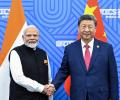
India and China celebrated the 75th anniversary of their diplomatic relations on Tuesday, with leaders from both countries exchanging congratulatory messages. The anniversary comes as the two countries are working to restore ties after a four-year freeze due to the military standoff in eastern Ladakh. Both countries have expressed a willingness to enhance strategic mutual trust and step up cooperation in various fields. The two sides are also exploring ways to rebuild ties and promote people-to-people exchanges.

In the meeting, Doval conveyed to Wang that peace and tranquillity in border areas and respect for the Line of Actual Control are essential for return of normalcy in bilateral ties, according to the ministry of external affairs.

India and China will resume direct flight services by the end of this month after a five-year gap, signaling an effort to rebuild ties strained by the border standoff in eastern Ladakh.
Citing media reports that China has built shelters in the Depsang area in Ladakh, the Congress on Saturday questioned the government's 'silence' over the issue and asked what steps were being taken by it to ensure status quo ante of April 2020.

'China killed our soldiers. China took our land. Then, why is China praising Mr Modi during this conflict,' he asked on Twitter.

"When we have something to share, we will share. Discussions are ongoing," External Affairs Ministry Spokesperson Anurag Srivastava said replying to a volley of questions on whether India and China are working on specific proposals to resolve the over six-month-long row in eastern Ladakh.
The focus of the deliberations was on finalising modalities for disengagement of troops in eastern Ladakh.

Chinese Foreign Minister Wang Yi arrived in India Thursday evening in the highest-level visit between the two countries after the ties came under severe strain following the eastern Ladakh standoff nearly two years ago.
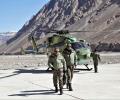
General Manoj Chandrasekhar Pande visited forward areas in Ladakh for the first time after he took over as chief of the army staff on Saturday, May 14, 2022.

The agreement was to disengage from remaining standoff sites along the Line of Actual Control (LAC), two days before a meeting between Chinese President Xi Jinping and Prime Minister Narendra Modi on the sidelines of the BRICS Summit.

Defence Minister Rajnath Singh has conveyed to his Chinese counterpart Admiral Dong Jun that India and China should maintain the positive momentum in the bilateral ties and avoid adding new complexities.

The Congress party has criticized the Modi government's approach to China following Prime Minister Narendra Modi's meeting with Chinese President Xi Jinping, questioning whether the government is legitimizing Chinese aggression.
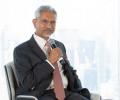
External Affairs Minister S Jaishankar is scheduled to visit China for an SCO conclave, marking a significant step in easing tensions after the 2020 border standoff. Discussions on the boundary dispute are also anticipated.

As the military standoff between India and China drags on along the Line of Actual Control (LAC) in eastern Ladakh, Defence Minister Rajnath Singh said the talks between the two sides are going on well and indicated hope for a resolution of the lingering row.

India has been maintaining that its ties with China cannot be normal unless there is peace in the border areas.
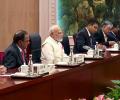
India is committed to taking forward its ties with China based on mutual trust, respect and sensitivity, Prime Minister Narendra Modi told Chinese President Xi Jinping as the two leaders held wide-ranging talks to reset the bilateral relations.

India and China will complete the disengagement process in the Gogra-Hotsprings area in eastern Ladakh by September 12, the External Affairs Ministry said on Friday.

Army Chief Gen Manoj Pande conducts a comprehensive review of the overall security situation in eastern Ladakh.

The India Army troops rose to the occasion to the challenges along the northern border as likely contingencies and possible options were war-gamed beforehand, Army Chief Gen M M Naravane said on Wednesday, referring to the eastern Ladakh standoff with China.

'It is flabbergasting to think that this heavenly region has, for decades, been coveted by India's aggressive neighbours,' says Claude Arpi after a recent visit to Ladakh. 'Wanting to use the newly created infrastructure to defend the borders after the clash of 2020 with China and the resulting standoffs, the home ministry is keen to boost border tourism to show that these areas are controlled by India.'

The T-72 tank with five soldiers on board sank due to flash floods while they were crossing the river.
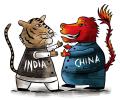
India and China achieved a major milestone this year when their bilateral trade crossed the landmark figure of $100 billion but it did not generate any fanfare in both capitals as the two Asian giants are going through a "particularly bad patch" in their relations due to a set of actions by Beijing in violation of agreements that led to the military standoff in eastern Ladakh. Starting with a modest $1.83 billion in 2001, the bilateral trade crossed $100 billion-mark in the first 11 months this year, a significant milestone for which the two countries carried out campaigns to boost trade and build it as a major stakeholder to improve the relations between two nations, whose ties otherwise remained frosty over the festering boundary dispute and strategic rivalry. According to last month's data from China's General Administration of Customs (GAC), the India-China bilateral trade totalled $114.263 billion, up 46.4 per cent year-on-year from January to November 2021.
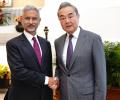
China promised to address three key concerns of India, the sources said.
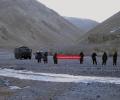
India and China have resolved the stand-off at the Ladakh border and withdrawal of troops will begin on Friday and be completed by September 30, External Affairs Minister Sushma Swaraj said describing the resolution of the issue as a "big accomplishment."

A total of 750 pilgrims have been selected through a computerised draw for the upcoming Kailash Manasarovar Yatra in Tibet, marking the resumption of the pilgrimage after a five-year gap. The Yatra's resumption is seen as an attempt to normalize India-China relations, which were strained by the eastern Ladakh border standoff. The pilgrimage will begin in June and continue until August, with pilgrims traveling in five batches via the Lipulekh route and ten batches via the Nathu La route. The selection process was deemed "fair, computer-generated, random, gender-balanced" by the Ministry of External Affairs (MEA), which organized the pilgrimage.
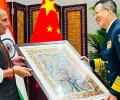
Defence Minister Rajnath Singh, in his meeting with Chinese counterpart Dong Jun in Qingdao on June 26, proposed that India and China should solve the "complex issues" under a structured roadmap comprising steps to de-escalate tensions along the frontiers and rejuvenate the existing mechanism to demarcate the borders.

National Security Advisor Ajit Doval stated that India-China relations have shown an "upward trend" in the past nine months, with peace prevailing along the Line of Actual Control (LAC). This statement was made during talks with Chinese Foreign Minister Wang Yi on the boundary issue, ahead of Prime Minister Modi's visit to China for the SCO summit.

India and China reviewed the situation along the Line of Actual Control (LAC) in eastern Ladakh and prepared for the next Special Representatives' dialogue on the boundary question.
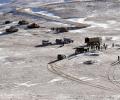
The Indian and Chinese troops are locked in an over three-year confrontation in certain friction points in eastern Ladakh even as the two sides completed disengagement from several areas following extensive diplomatic and military talks.

The fierce battles of Galwan, Rezang La, Gurung Hill, and Walong taught the PLA a hard lesson: Fighting the Indian Army would never be easy or inexpensive.

During the session, General Dwivedi was asked about the overall challenges for the India Army going forward and learning from the border row in eastern Ladakh.

Jaishankar also said that there is a need to take the disengagement process forward.
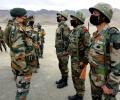
India and China have held several rounds of talks at the diplomatic and military-level to resolve the standoff that erupted in early May.
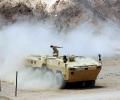
Northern Army Commander Lieutenant General Upendra Dwivedi reviewed Exercise Red Hunt in Ladakh where lethality, survivability, mobility and situational awareness was demonstrated, exploiting newly inducted weapons and equipment in that operational theatre where the Indian Army's soldiers have been engaged in a military standoff with the Chinese People's Liberation Army since April 2020.
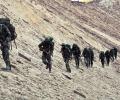
"Some steps are required for full normalcy, we have not reached there," Bagchi said.

The govt said that the issue is sensitive and related to national security and thus can't be made public.

Members of the Congress also walked out of the Lok Sabha and staged a sit-in in the Parliament House complex after they were not allowed to speak following a statement by Defence Minister Rajnath Singh on the border standoff with China in eastern Ladakh.

Indian graziers were stopped by Chinese troops from moving ahead near the Line of Actual Control (LAC) in the Demchok region of eastern Ladakh over a week ago, people familiar with the development said on Monday.

'Tensions and dialogue are likely to go hand-in-hand with China.' 'The goal should be to cultivate power so that one can negotiate from a position of strength.'
